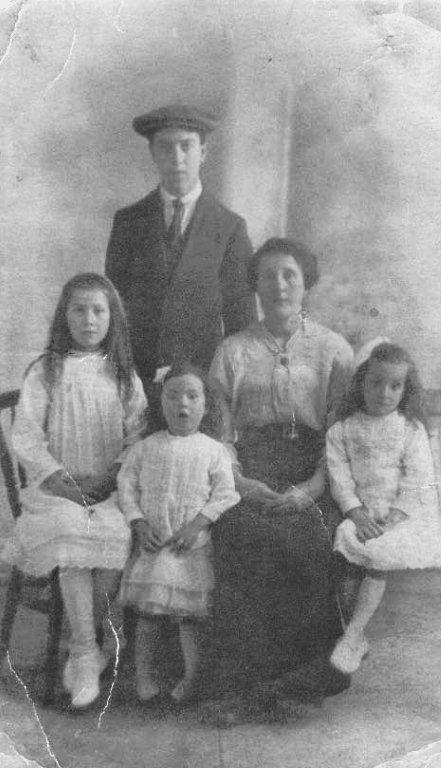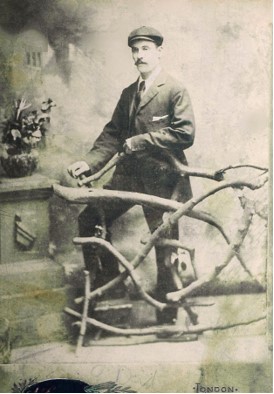
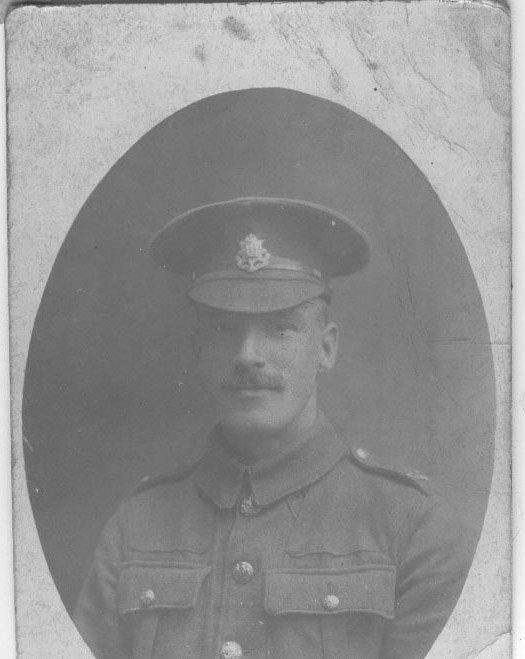
Private 8217 WILLIAM CHARLES ADAMS 9th Bn., East Surrey Regiment.
Early Life in Lambeth, 1878–1901
William Charles Adams was born on 9 May 1878 at Jonathan Street in Lambeth, London, the son of George Adams, a gas stoker, and Selina Adams (née Manning), both originally from Bath, Somerset. One of ten children, William grew up in the streets around Wood Street, Princes Road and the well-known Lambeth Walk. Wood Street was later renamed Brittany Street, while Princes Road became Black Prince Road.
He was baptised on 2 June 1878 at St Mary the Less Church in Princes Road, Kennington, only a short distance from Wood Street. By the time of the 1891 census, his father had died. William, then aged thirteen, was living with his widowed mother, Selina, who worked as a laundress, and several of his siblings: George T., Selena, James, Joseph E. and Rosetta. Already employed as an errand boy, William had begun the working life that would remain closely tied to his local community.
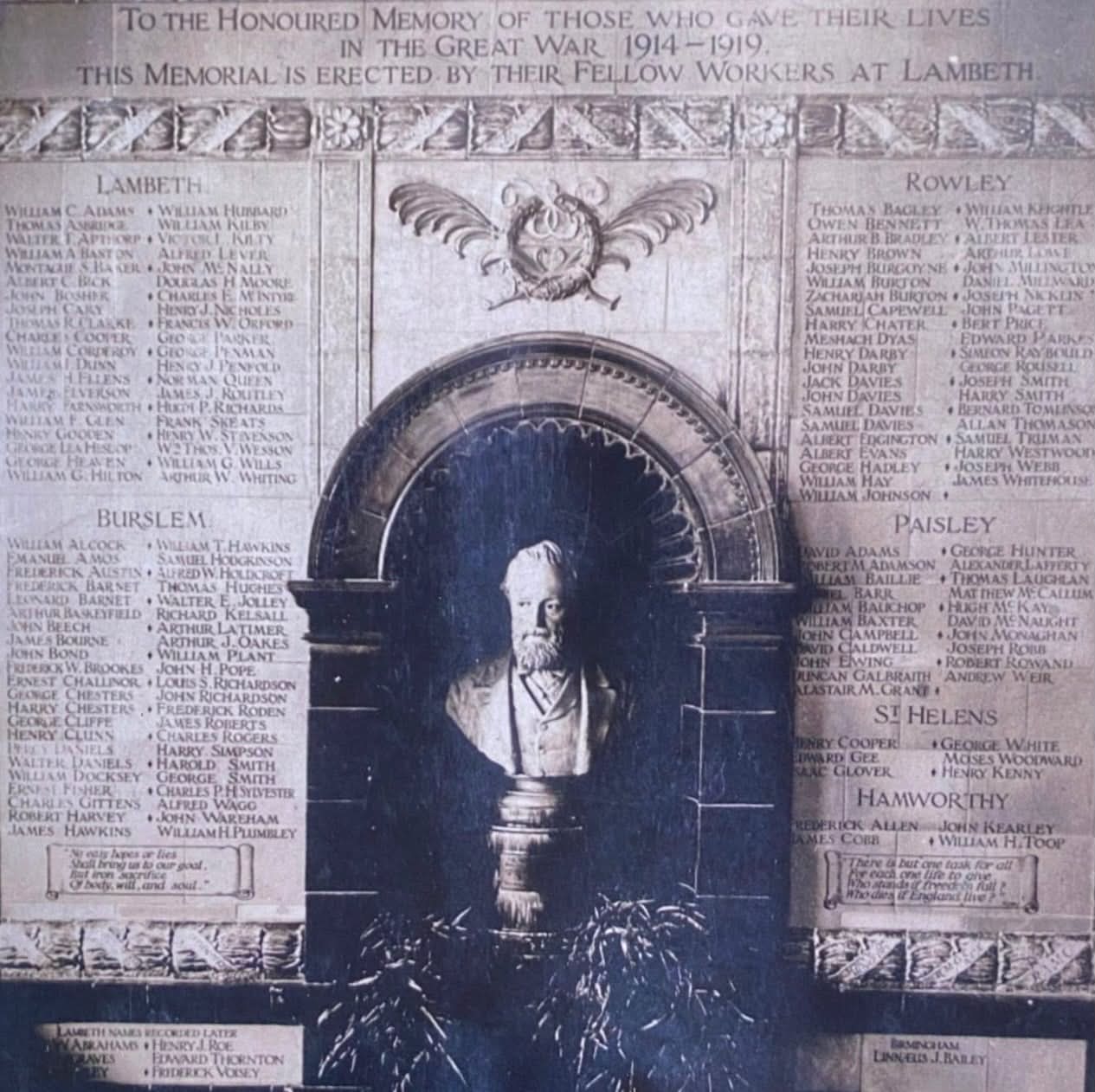
As a young man, he found employment at the nearby Lambeth Doulton pottery works. The 1901 and 1911 censuses record him as a potter’s labourer, the same occupation later entered on his military service papers.
Marriage and Family
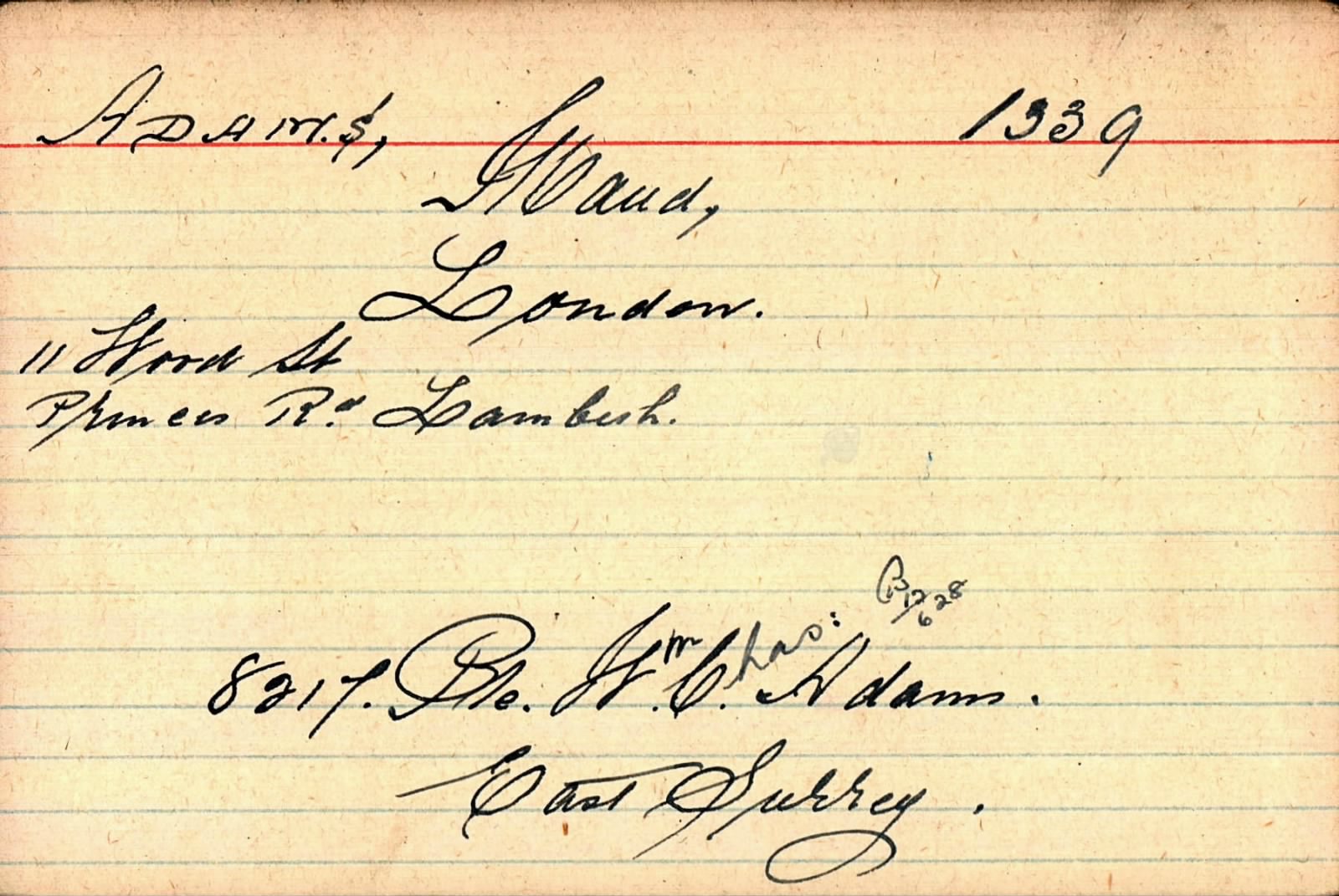
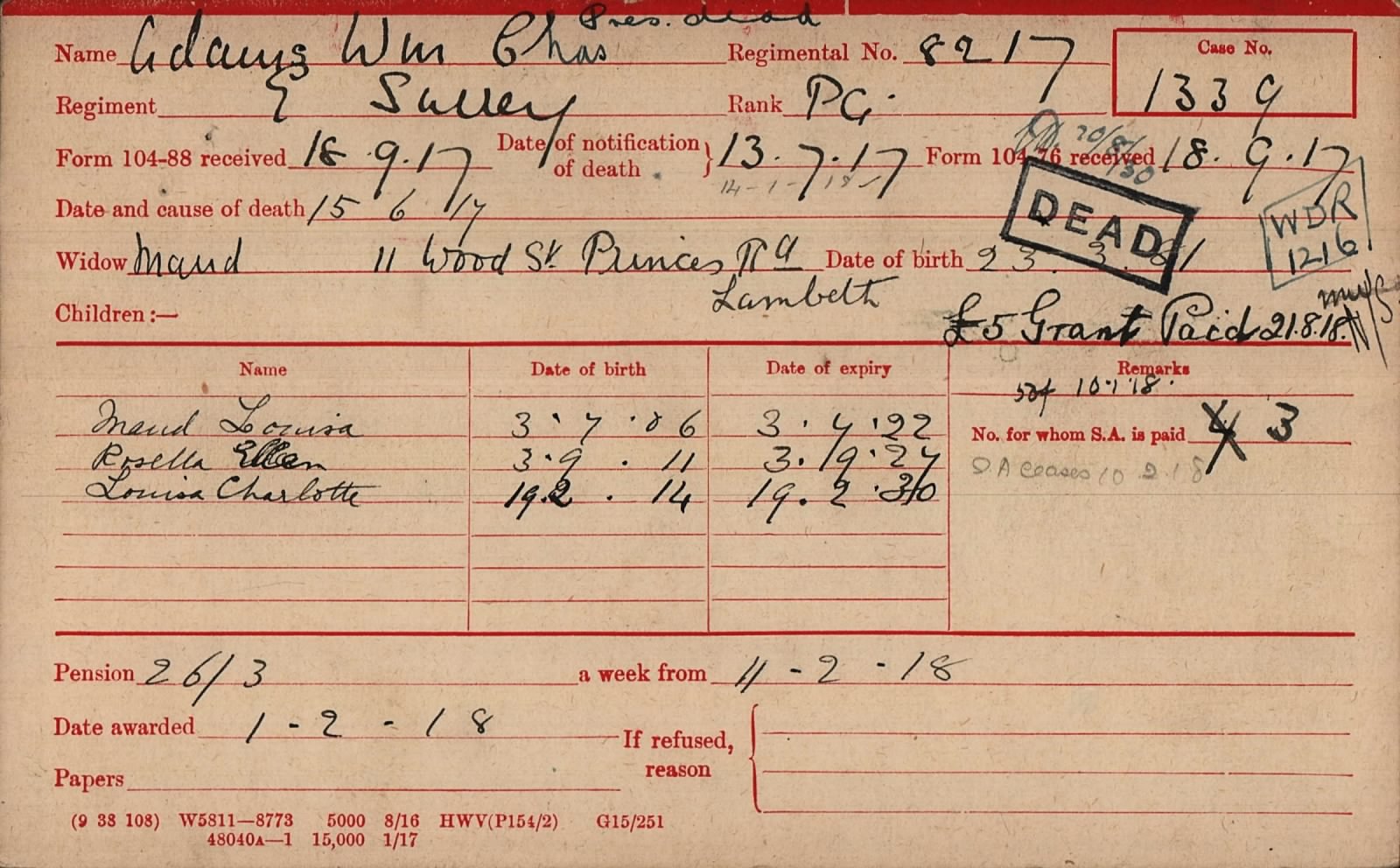
On 1 September 1901, William married Maud Amelia Pratt at St Paul’s Church, Newington. They made their home at 11 Wood Street, Lambeth, and had six children:
- William Christopher, born 16 September 1901; died 1941
- Edward James, born 1904; died 1905
- Maud Louisa, born 3 July 1906; died 2001
- George James, born 1909; died 1910
- Rosetta Ellen, born 30 September 1911; died 1972
- Louisa Charlotte, born 19 February 1914; died 2008
William continued working as a potter’s labourer at Lambeth Doulton throughout these years, supporting his growing family in the neighbourhood where he had been raised.
Military Service, 1915–1916
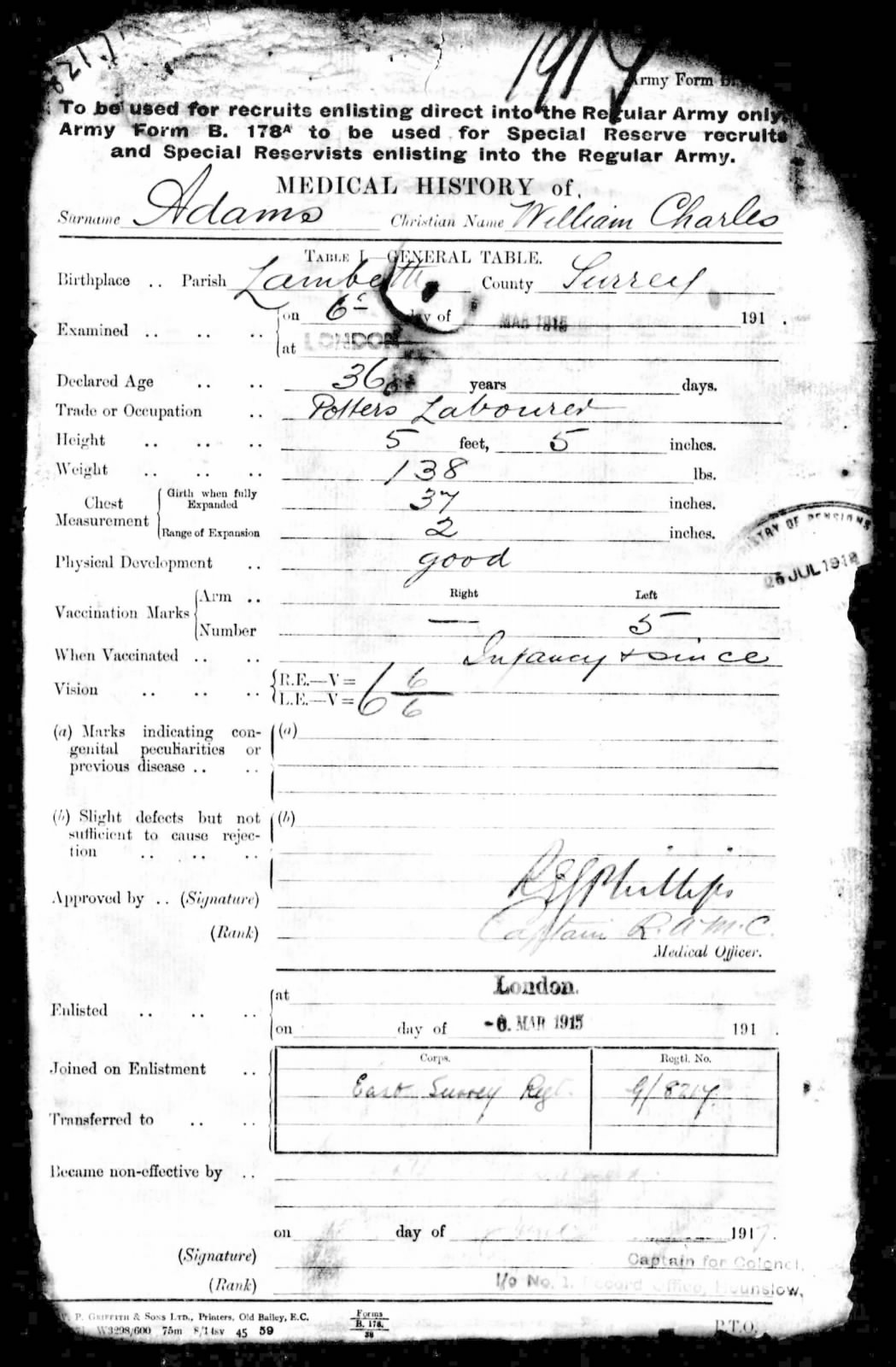
At the age of thirty-six, William volunteered for service during the First World War. He attested in London on 6 March 1915 and joined the East Surrey Regiment under service number G/8217. His papers describe him as 5 feet 5 inches tall and weighing 138 pounds, with a 37-inch chest, two inches of expansion and 6/6 vision. He was recorded as Church of England, vaccinated in infancy, and employed as a potter’s labourer. His address remained 11 Wood Street, Princes Road, Lambeth.
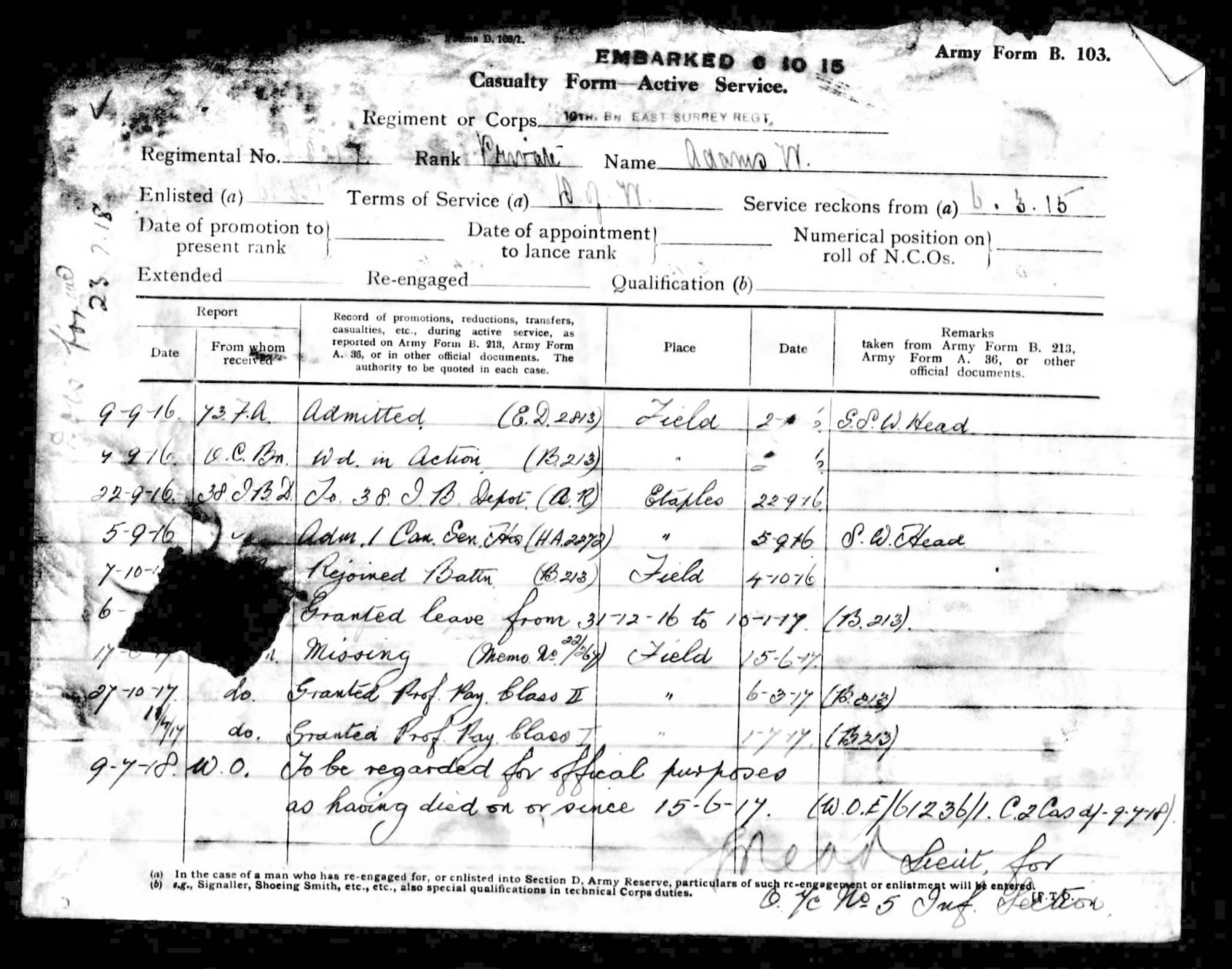
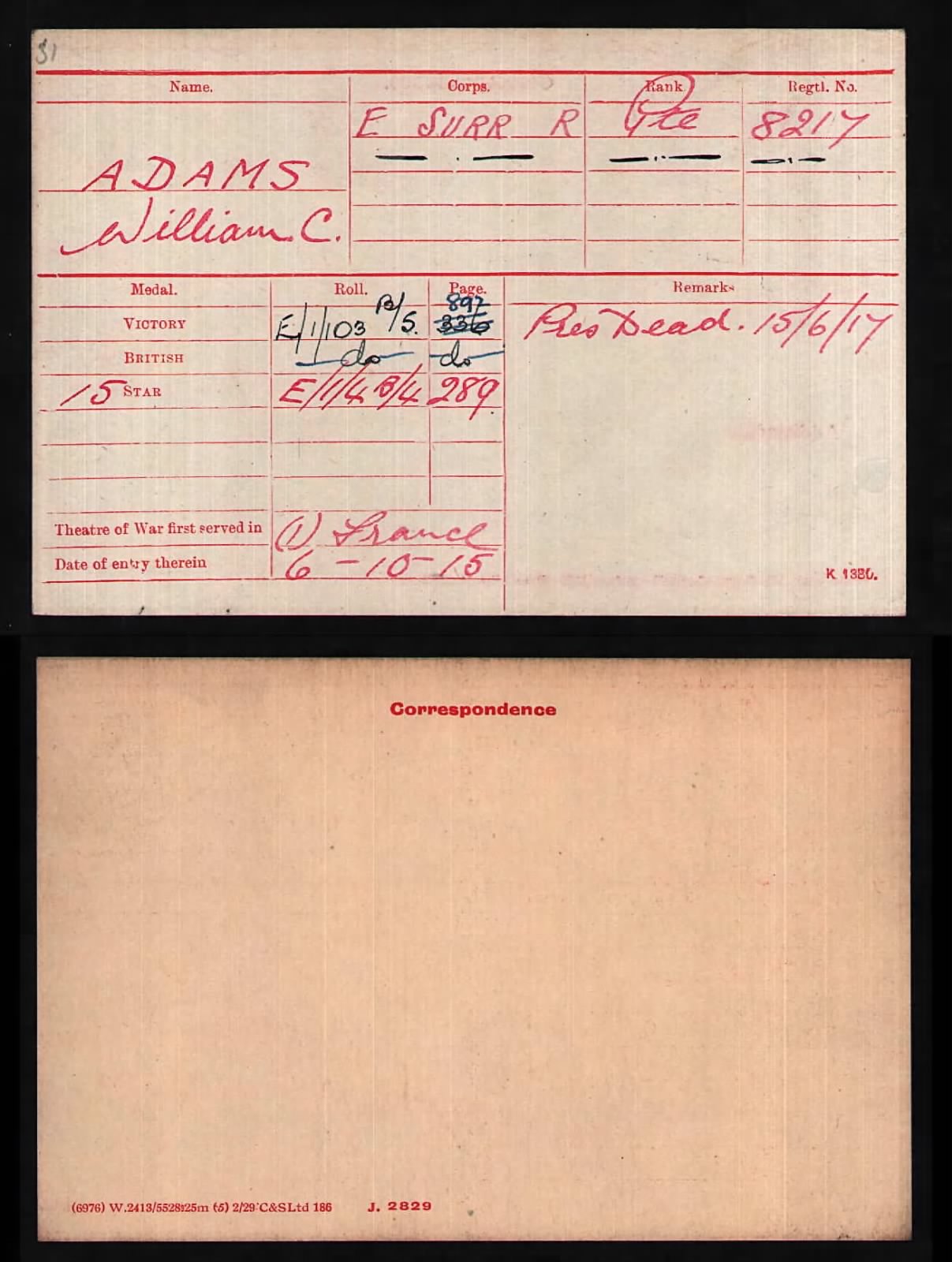
William entered the theatre of war in France on 6 October 1915. He subsequently took part in major engagements, including the Battle of the Somme. On 7 September 1916, he was wounded in action by shrapnel to the head and admitted to hospital two days later. On 22 September he was transferred to No. 38 Infantry Base Depot at Étaples, and on 7 October he rejoined his battalion. He was granted leave from 31 December 1916 until 10 January 1917.
Ypres and Death, 1917
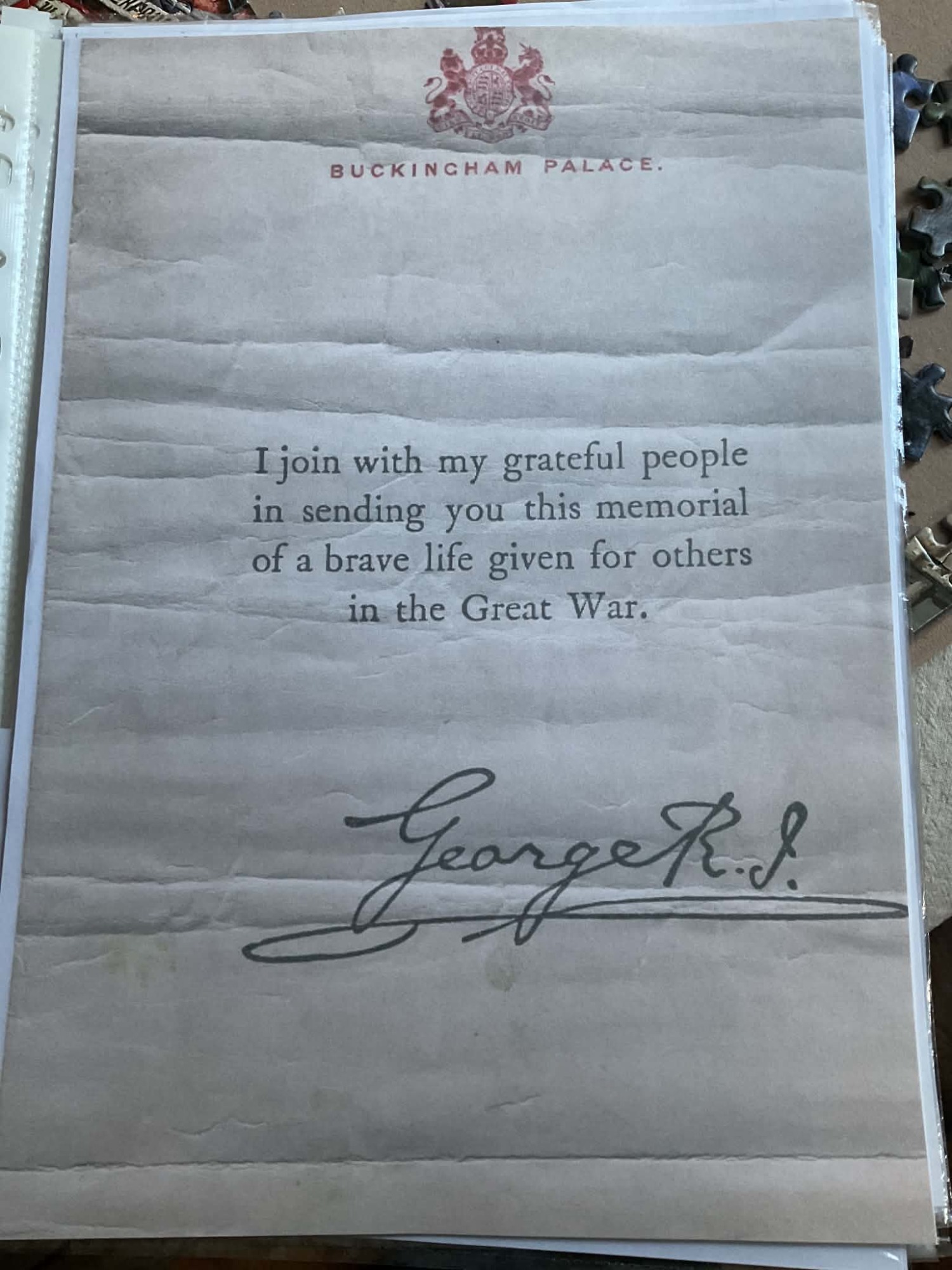
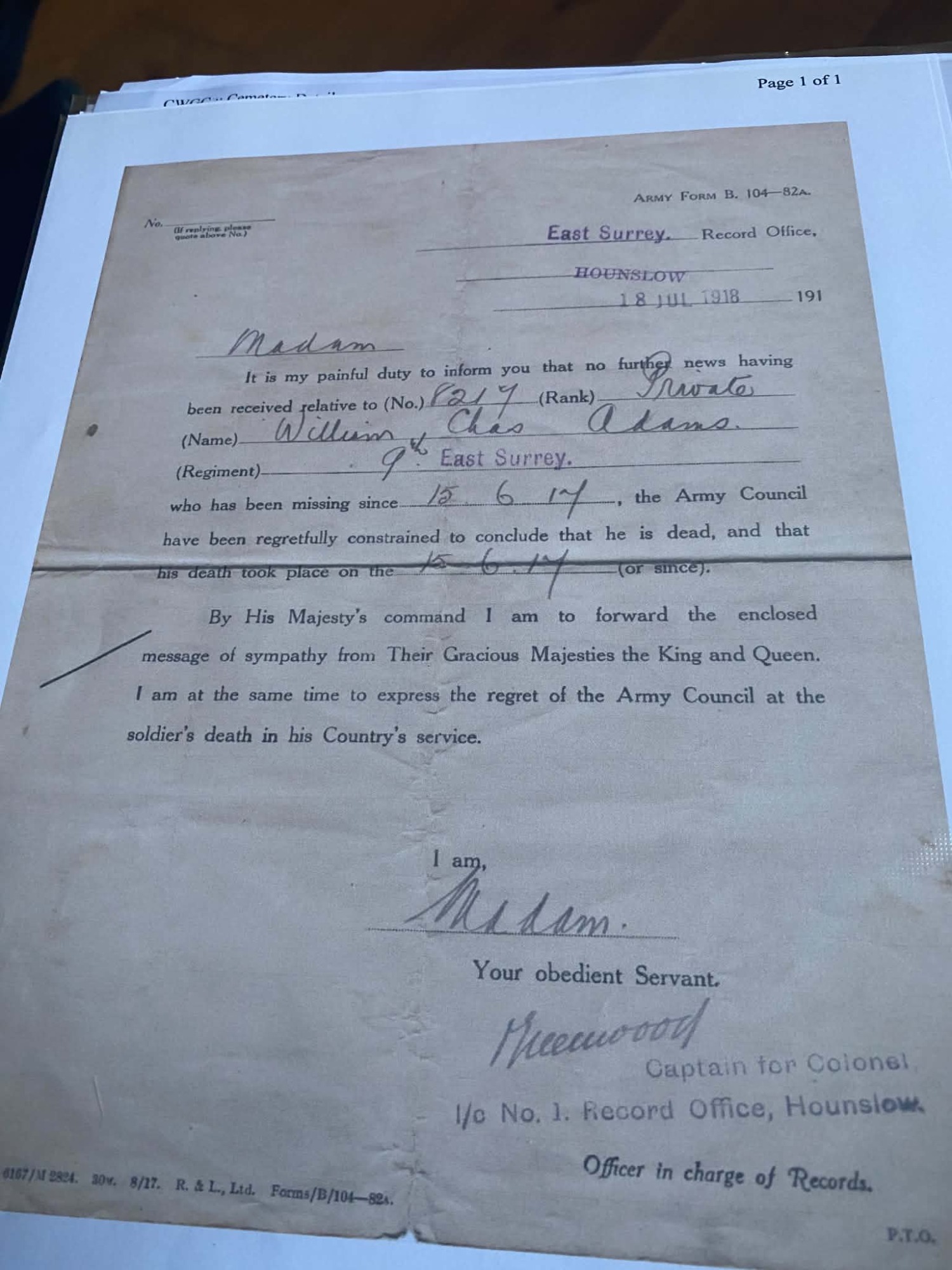
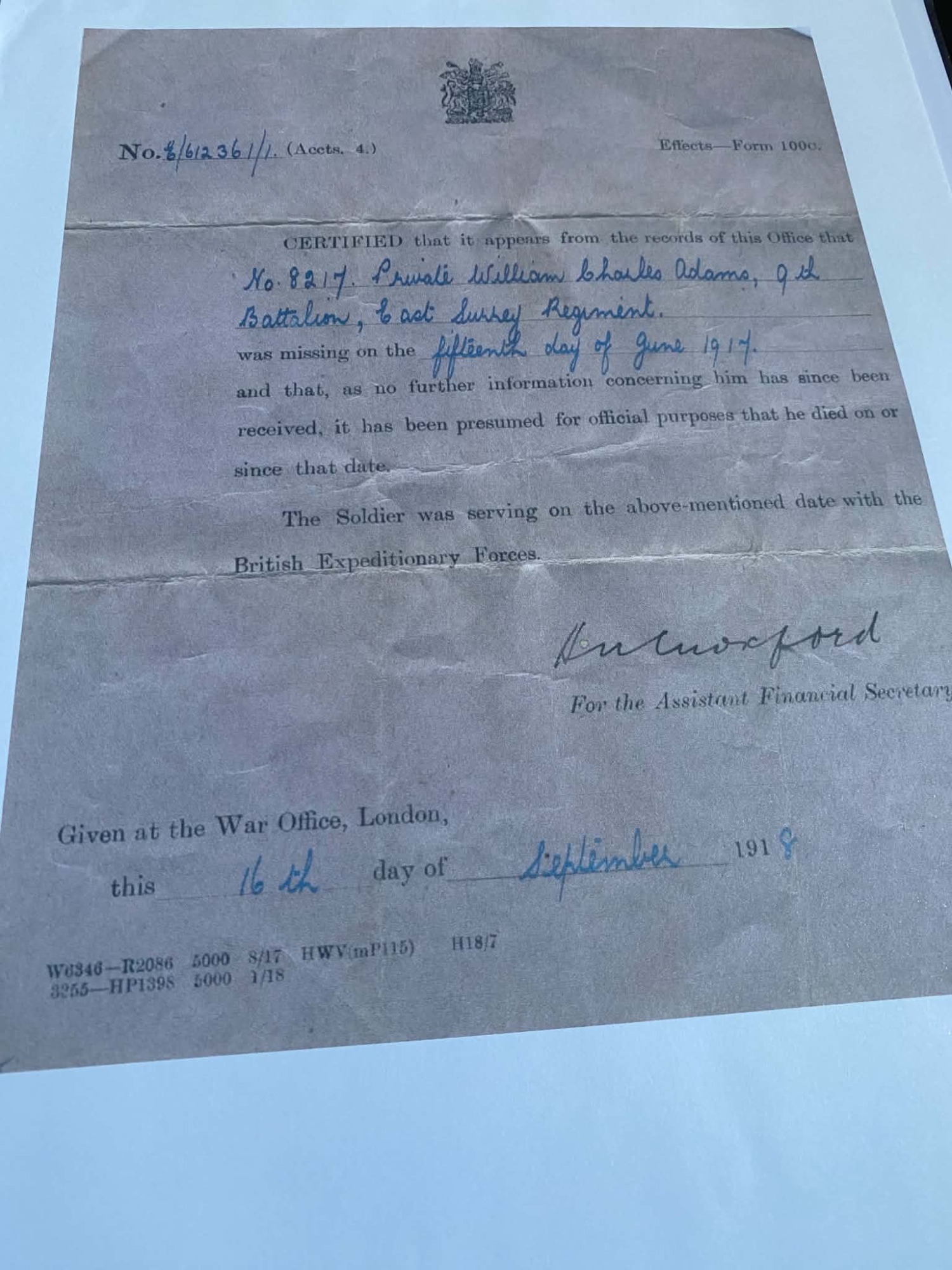
William returned to active service and was involved in the fighting around Ypres. On 15 June 1917, while sheltering in a tunnel, he was killed when it collapsed after an explosion. His body was never recovered, and the official record stated that he was “to be regarded for official purposes as having died on or since 15 June 1917.”
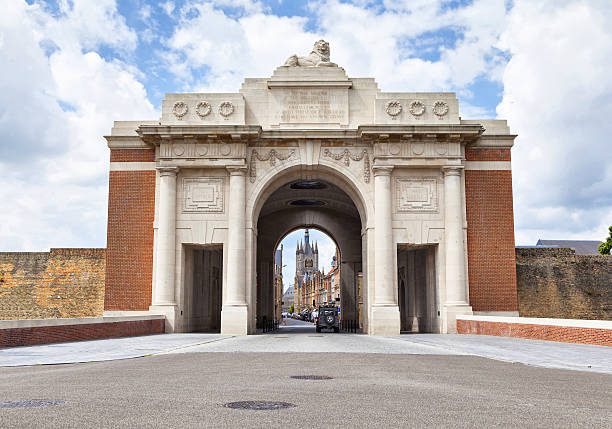
William Charles Adams is commemorated on the Menin Gate at Ypres, among the thousands of servicemen who have no known grave. He was awarded the 1915 Star, the British War Medal and the Victory Medal.
Historical Context
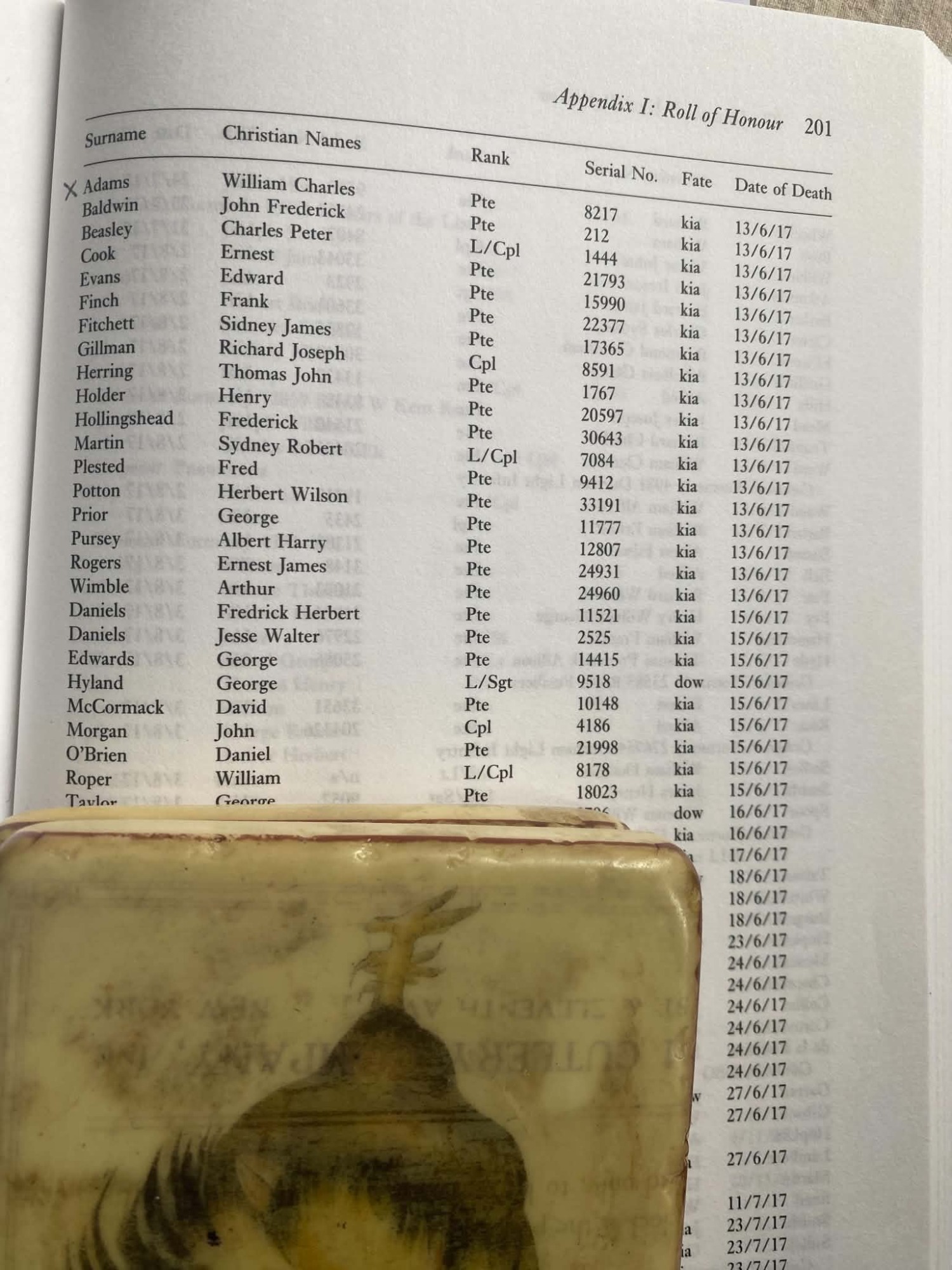
Michael Lucas’s account of the 9th East Surrey Regiment during the Messines and Pilckem Ridge operations records the circumstances of the loss: “‘B’ Company had the misfortune to have many men buried when a tunnel in which they were sheltering collapsed—eleven killed and twenty-eight wounded, crushed and shaken.”
Source: Lucas, M. (2017). Journey’s End Battalion: The 9th East Surrey in the Great War. Stroud: The History Press, p. 101.
Family contribution: remembered by Chris Williams
This biography is enriched by the contribution of Chris Williams, whose family knowledge has preserved William’s story through the generations. Chris also generously provided the photograph of the Lambeth Memorial and has undertaken extensive research into all the Lambeth men commemorated on the Doulton Lambeth memorial. We are deeply grateful for her dedication and hard work.
“William married my grandmother, Maud Amelia Pratt, at St Paul’s Church, Newington, on 1 September 1901. They had six children: William Christopher (1901–1941), Edward James (1904–1905), Maud Louisa (1906–2001), George James (1909–1910), Rosetta Ellen (1911–1972) and Louisa Charlotte (1914–2008).
In 1915, aged thirty-six, William volunteered for service with the East Surrey Regiment during the First World War. Sent to France, he fought in several major engagements, including the Somme. He suffered a head wound on 5 September 1916 and spent time in a French hospital. On 15 June 1917, he was killed during fierce fighting at Ypres when the tunnel sheltering him was blown up. His body was never recovered, and he is commemorated on the Menin Gate at Ypres.
William was awarded the Victory Medal, the British Medal and the 15 Star.”
Sources used.
- Ancestry (n.d.) 1881 England Census [database].
- Ancestry (n.d.) 1891 England Census [database].
- Ancestry (n.d.) 1911 England Census [database].
- General Register Office (1878) Birth certificate of William Charles Adams.
- Commonwealth War Graves Commission (n.d.) Casualty record for William Charles Adams [database].
- Forces War Records (n.d.) UK, WWI, British Army Service Records, 1914–1920 [database].
- Forces War Records (n.d.) Adams, William Charles (aged 36), in UK, WWI, British Army Service Records, 1914–1920 [database record].
- Forces War Records (n.d.) UK, British Army Registers of Soldiers’ Effects, 1901–1929 [database].
- Forces War Records (n.d.) Hounslow, 1914–1915, records 728501–730000, in UK, British Army Registers of Soldiers’ Effects, 1901–1929 [database record].
- Forces War Records (n.d.) UK, British Army Pension Records [database].